
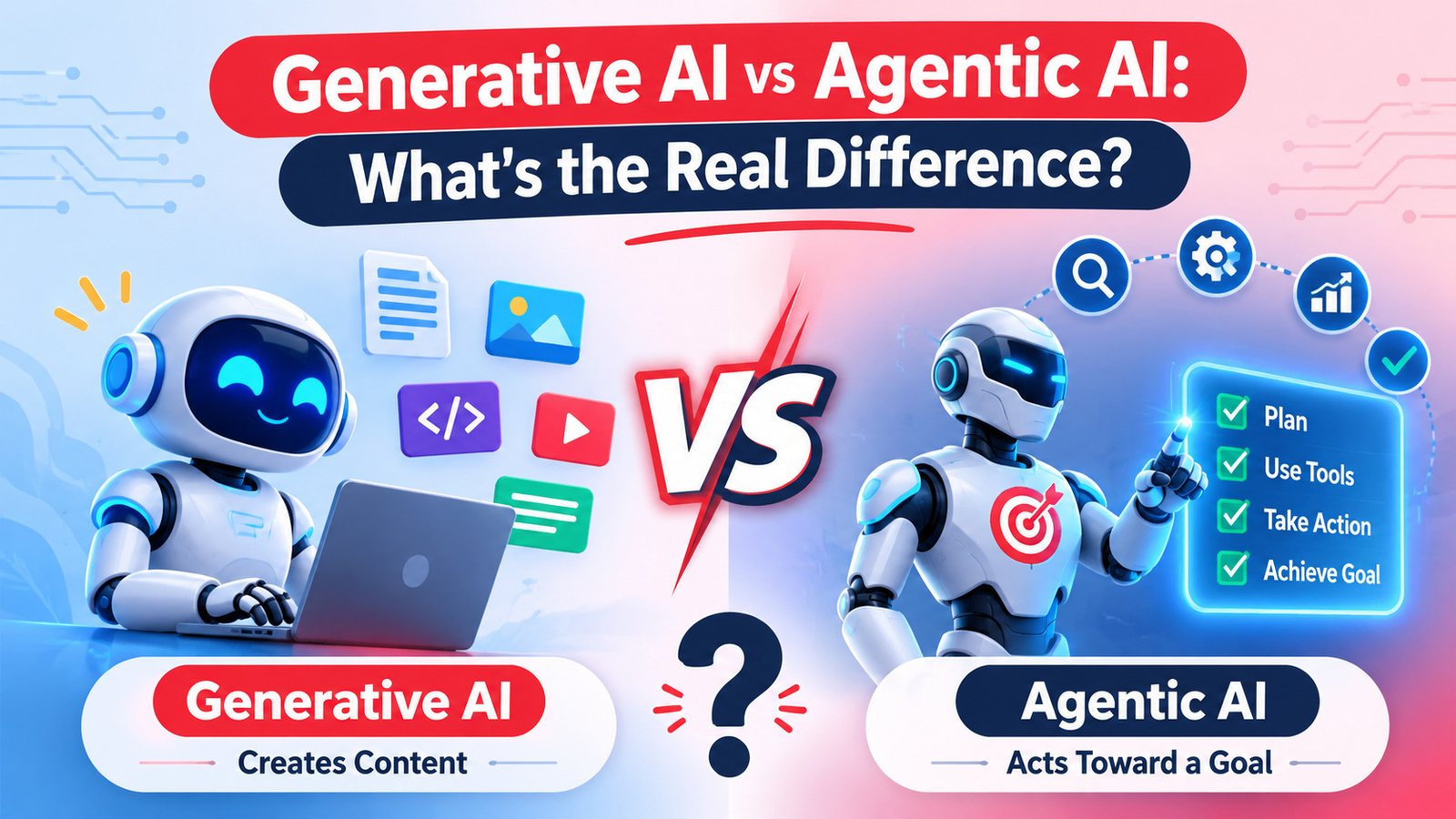
Generative AI vs Agentic AI: What's the Real Difference?
Artificial intelligence is changing how businesses operate and how people complete everyday tasks. Two important developments in this field are Generative AI and Agentic AI. Generative AI creates content such as text, images, videos, and code. Agentic AI uses AI models, tools, and data to complete tasks and achieve specific goals. Although both technologies are related, they have different purposes. In this guide, we will explore the key differences between Generative AI vs Agentic AI, their applications, benefits, and career opportunities.
What is Generative AI?
Generative AI is a type of artificial intelligence that creates new content based on patterns learned from training data and user instructions. It can generate:
- Text and articles
- Images and graphics
- Computer code
- Audio and videos
- Reports and summaries
- Translations
For example, a developer can ask an AI tool to write a Python function. The AI generates the code, and the developer reviews and tests it.
Common Applications of Generative AI
- Content Creation: Writing blogs, emails, product descriptions, and social media posts.
- Software Development: Generating code, explaining errors, and creating test cases.
- Research: Summarizing documents and organizing information.
- Media Creation: Generating images, audio, and videos.
To develop practical knowledge, Explore The Generative AI Course in Dallas at DFW IT Career.
What is Agentic AI?
Agentic AI refers to AI systems designed to achieve specific goals by planning tasks, using tools, evaluating results, and performing actions. Instead of simply answering a question, an agentic AI system can work through multiple steps. A typical workflow includes:
- Understanding the user's goal.
- Creating a task plan.
- Collecting information.
- Selecting appropriate tools.
- Performing actions.
- Checking results.
- Reporting the outcome.
A Simple Example of Agentic AI
Imagine a company wants to automate its IT support process. A traditional AI chatbot might suggest solutions to an account access problem. An agentic AI system could:
- Read the support request.
- Identify the account issue.
- Check approved information sources.
- Retrieve relevant account details.
- Create a support ticket.
- Request approval when necessary.
- Perform an authorized action.
This makes Agentic AI useful for business automation and complex workflows.
Generative AI vs Agentic AI: 5 Key Differences
1. Prompt-Driven vs Goal-Driven
Generative AI responds to specific instructions, while Agentic AI works toward broader objectives by planning multiple steps.
2. Content vs Actions
Generative AI creates content. Agentic AI can use connected tools to perform authorized actions.
3. Single-Step vs Multi-Step Tasks
Generative AI commonly handles individual requests, while Agentic AI can manage complete workflows.
4. Tool Integration
Generative AI may work without external tools. Agentic AI commonly integrates APIs, databases, and business applications.
5. Human Involvement
Generative AI often requires users to guide each task. Agentic AI can operate with less supervision, depending on its permissions and design.
How Do Generative AI and Agentic AI Work Together?
Generative AI and Agentic AI are not competing technologies. They often work together. Generative AI helps understand instructions, process information, and create content. The agentic layer manages tasks, selects tools, and coordinates actions. For Example, An AI agent can research different products, collect information, compare features, and generate a final report. This combination helps businesses automate complex processes and improve productivity.
Real-World Use Cases of Generative AI and Agentic AI
Generative AI applications:
- Content generation
- Software development assistance
- Image and video creation
- Document summarization
- Language translation
- Educational support
Agentic AI applications:
- IT support automation
- Customer service workflows
- Business process automation
- Research and data analysis
- Software development workflows
- Enterprise system integration
For a broader understanding of artificial intelligence, Explore The AI & Machine Learning Course at DFW IT Career.
Benefits of Generative AI
- Faster content production
- Improved productivity
- Coding assistance
- Easier access to technical information
- Faster prototyping and idea development
However, Generated information should be reviewed to avoid factual errors and misleading results.
Benefits of Agentic AI
- Automated business workflows
- Integration with external tools
- Goal-oriented task execution
- Multi-step decision-making
- Collaboration between specialized AI agents
These benefits depend on proper system design, permissions, testing, and monitoring.
What Are the Risks of Agentic AI?
Agentic AI can perform actions through connected systems, which creates additional security concerns. Some common risks include:
- Incorrect automated actions
- Data privacy problems
- Unauthorized system access
- Prompt injection attacks
- Excessive permissions
- Insufficient monitoring
Businesses should use proper authentication, access controls, testing, monitoring, and human approval for sensitive operations. Learn more about identity and access security through DFW IT Career's Cyber Security (IAM) Course.
Which Should You Learn First: Generative AI or Agentic AI?
For beginners, learning AI fundamentals and Generative AI is a practical starting point. Focus on understanding:
- AI and machine learning basics
- Large language models (LLMs)
- Prompt engineering
- Python programming
- APIs and data handling
- Responsible AI practices
After building these skills, you can explore AI agents, tool calling, workflow automation, and multi-agent systems. Your learning path may also depend on your background in software development, QA, cybersecurity, or business analysis.
Frequently Asked Questions
1. Is Agentic AI the Same as Generative AI?
No. Generative AI creates content, while Agentic AI focuses on completing goals through planning, tool usage, and actions.
2. Is ChatGPT Generative AI or Agentic AI?
ChatGPT is primarily a generative AI application. However, applications using language models can also include agentic capabilities.
3. Can Agentic AI Work Without Generative AI?
Yes. However, many modern AI agents use generative models for understanding instructions, planning, and creating content.
4. Which Is Better for Business Automation?
Agentic AI is generally more suitable for complex workflows, while Generative AI works well for individual content-generation tasks.
5. Is Agentic AI Fully Autonomous?
No. Its autonomy depends on system design, permissions, and human approval requirements.
6. Does Learning Generative AI Help With Agentic AI?
Yes. Knowledge of LLMs, prompting, APIs, and AI fundamentals provides a useful foundation for learning Agentic AI.
Final Thoughts: Generative AI vs Agentic AI
Generative AI and Agentic AI are two important developments in artificial intelligence. Generative AI focuses on creating content, while Agentic AI focuses on completing tasks and achieving goals through multiple steps.
Both technologies have valuable applications in modern businesses. Understanding how they work together can help IT professionals develop relevant technical skills and prepare for emerging opportunities.