Router vs Switch vs Firewall: A Beginner's Guide
 Sep 17, 2026
 10:41 AM
Router vs Switch vs Firewall: A Beginner's Guide
If you're just starting to learn computer networking, three terms appear almost immediately: router, switch, and firewall.
At first, they can seem interchangeable because all three are involved in moving, controlling, or protecting network traffic. But they perform different jobs.
A simple way to remember the difference is:
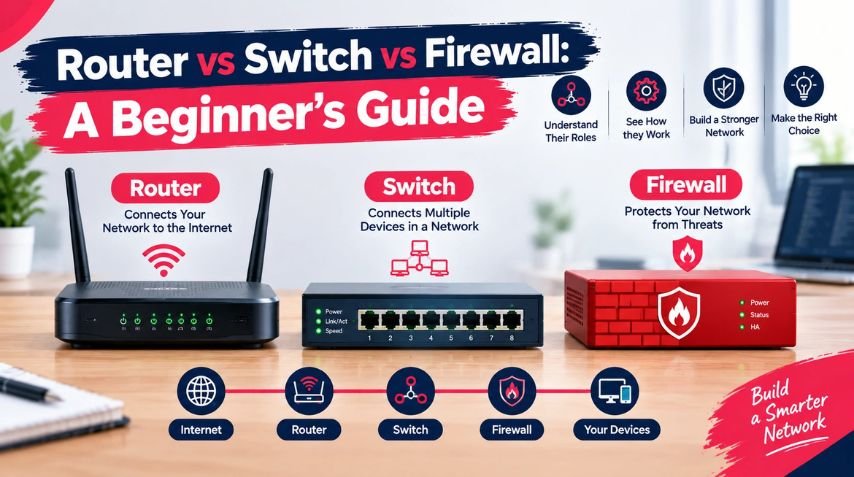
- A switch connects devices within a network.
- A router connects different networks.
- A firewall controls and protects traffic according to security rules.
In a typical business network, you may use all three together.
Understanding the difference between a router vs switch vs firewall is important whether you're preparing for a networking certification, starting an IT career, or simply trying to understand how business networks work.
Cisco describes switches as foundational networking devices that connect computers, printers, servers, and other devices within a local network. Routers connect networks to other networks and determine where IP traffic should go, while firewalls inspect traffic and allow or block it according to security policies.
Let's break everything down in beginner-friendly language.
Router vs Switch vs Firewall: Quick Comparison
Before going into the details, here's the simplest comparison:
Device
Main Purpose
Commonly Works With
Primary Job
Router
Connects networks
IP addresses
Routes traffic between networks
Switch
Connects devices
MAC addresses
Forwards traffic within a LAN
Firewall
Protects networks
Security policies, IPs, ports, applications
Allows or blocks traffic
Router + Firewall
Connectivity + security
Routing and security rules
Connects and protects networks
Layer 3 Switch
Switching + routing
MAC and IP addresses
Connects devices and performs routing
The exact capabilities vary by device. Modern enterprise equipment can combine functions, so the physical device you see in a network is not always dedicated to only one role. Cisco notes that modern switches can include routing and security capabilities, while some routers can include firewall functionality.
What Is a Network Switch?
Let's start with the device that beginners often find easiest to understand: the network switch.
A switch connects multiple devices on the same local network.
Imagine an office with:
- 20 computers
- 3 printers
- 2 servers
- Several IP phones
- Wireless access points
You need a way for these devices to communicate with each other.
A network switch provides that connection.
Cisco explains that switches connect devices such as computers, printers, and servers within a LAN and forward traffic toward the appropriate destination.
How Does a Switch Work?
A traditional Layer 2 switch primarily uses MAC addresses to make forwarding decisions.
Every network interface has a MAC address.
When a device sends an Ethernet frame through a switch, the switch can learn which MAC address is associated with which port.
Over time, the switch builds a MAC address table.
For example:
Device
MAC Address
Switch Port
PC-01
AA:11:22:33:44:55
Port 1
PC-02
BB:22:33:44:55:66
Port 2
Printer
CC:33:44:55:66:77
Port 3
Server
DD:44:55:66:77:88
Port 4
If PC-01 needs to communicate with PC-02, the switch can use the destination MAC address to forward the frame toward the correct port.
This is more efficient than simply sending the traffic to every connected device.
What Is a Switch Used For?
Switches are commonly used to:
- Connect computers
- Connect servers
- Connect printers
- Connect IP phones
- Connect wireless access points
- Expand wired network connectivity
- Create VLANs on managed switches
- Segment devices within a LAN
- Support enterprise network infrastructure
Managed vs Unmanaged Switches
Beginners should also understand the difference between managed and unmanaged switches.
An unmanaged switch is generally designed for simple plug-and-play connectivity.
A managed switch provides configuration and monitoring capabilities. Depending on the model, administrators may configure VLANs, security controls, Quality of Service, port settings, and other networking features.
For professional networking careers, understanding managed switches is particularly important.
What Is a Router?
A router connects different networks.
While a switch primarily connects devices within a local network, a router determines how traffic should move between networks.
For example:
Your laptop → Office LAN → Router → Internet
The router acts as a traffic director.
Cisco explains that routers connect networks and use IP information to determine where packets should be sent.
How Does a Router Work?
Routers make forwarding decisions using information such as destination IP addresses and routing tables.
Imagine your computer wants to access a website hosted somewhere on the Internet.
Your computer knows the destination IP address isn't part of its local network.
It therefore sends the traffic toward its default gateway, typically a router or Layer 3 device.
The router examines the destination IP address and determines where the packet should go next.
That process continues across multiple networks until the packet reaches its destination.
What Is a Router Used For?
Routers can be used to:
- Connect a local network to the Internet
- Connect different office networks
- Connect branch locations
- Route IPv4 and IPv6 traffic
- Support WAN connectivity
- Connect different IP subnets
- Perform routing between VLANs
- Provide gateway functionality
- Support network services depending on the device
Routing becomes increasingly important as networks grow because there may be many possible paths between destinations.
What Is a Firewall?
A firewall is primarily a security control.
Its job is to inspect network traffic and apply security rules to determine what traffic should be allowed or blocked.
Cisco describes a firewall as a security mechanism that monitors incoming and outgoing traffic and makes allow-or-block decisions based on defined rules.
Think of a firewall as a security checkpoint.
A router might determine:
"Where should this packet go?"
A firewall might determine:
"Should this traffic be allowed to pass?"
That distinction is important.
How Does a Firewall Work?
A firewall can evaluate traffic using information such as:
- Source IP address
- Destination IP address
- Port number
- Protocol
- Connection state
- Application information
- Security policies
The exact capabilities depend on the firewall technology.
Traditional firewalls may use packet filtering and stateful inspection, while modern next-generation firewalls can provide additional capabilities such as application visibility, intrusion prevention, URL filtering, and malware defenses.
Why Do Businesses Need Firewalls?
A business network may contain:
- Employee computers
- Servers
- Databases
- Customer information
- Cloud services
- Internal applications
- Remote-access systems
Not every connection should automatically be trusted.
A firewall helps organizations enforce security policies around network traffic.
For example, an organization might create rules that allow certain business applications while restricting unnecessary inbound connections from the public Internet.
Firewall configuration should be based on the organization's actual security requirements rather than simply enabling random rules.
Router vs Switch: What's the Difference?
The biggest difference between a router and switch is what they connect and how they make forwarding decisions.
A Layer 2 switch generally connects devices within a LAN and uses MAC addresses for forwarding.
A router connects different networks and uses IP addressing and routing information to determine where traffic should go.
Simple Example
Suppose your office has:
Network A: 192.168.10.0/24
Network B: 192.168.20.0/24
A switch can connect devices within each local network.
But traffic moving from Network A to Network B requires a Layer 3 routing function.
That's where a router—or a Layer 3 switch—can be used.
Router vs Firewall: What's the Difference?
Routers and firewalls can both influence network traffic, but their primary purposes are different.
Router
The router's primary job is:
Connect networks and route packets.
Firewall
The firewall's primary job is:
Enforce security policies on traffic.
A router may have built-in security features, and some routers include firewall functionality.
Likewise, modern security appliances may perform routing functions.
That doesn't mean routing and firewalling are the same thing.
They solve different networking problems.
Cisco's current guidance also notes that some secure routers integrate next-generation firewall functionality, illustrating why modern network devices can blur the traditional boundaries.
Switch vs Firewall: What's the Difference?
A switch is mainly concerned with network connectivity, while a firewall is concerned with traffic security.
For example:
A switch might connect 30 computers inside an office.
A firewall might control whether those computers are allowed to access particular external services or whether unsolicited traffic from an external network can reach internal systems.
Some advanced switches include security capabilities, but a switch should not automatically be treated as a replacement for a dedicated firewall.
The right architecture depends on the network's size, security requirements, device capabilities, and organizational policies.
How Router, Switch, and Firewall Work Together
Now let's put the three devices into a realistic network.
Imagine a small company with 50 employees.
A simplified network might look like this:
Internet
↓
Firewall
↓
Router / Layer 3 Gateway
↓
Network Switch
↓
Computers / Servers / Printers / Access Points
The exact topology can vary because modern network appliances often combine functions.
But conceptually, each component has a different responsibility.
Step 1: The Switch Connects Devices
Employees' computers connect to switches.
The switch provides local network connectivity.
Step 2: The Router Connects Networks
When traffic needs to leave the local subnet or reach another network, routing functionality determines the appropriate path.
Step 3: The Firewall Enforces Security
Traffic crossing a security boundary is evaluated against the organization's firewall policy.
Depending on the configuration, traffic may be allowed, denied, inspected, logged, or subjected to additional security controls.
A Real-World Example
Let's say an employee opens a website from an office computer.
Here's a simplified version of what happens.
1. The computer creates network traffic
The employee enters a website address into a browser.
The operating system determines where the traffic needs to go.
2. The switch forwards local traffic
If the computer is connected to a switch, the switch forwards the Ethernet frame toward the appropriate destination.
3. The default gateway receives the traffic
If the destination is outside the local subnet, the traffic is sent toward the default gateway.
4. Routing determines the next path
The router or Layer 3 gateway determines where the IP packet should go next.
5. Firewall policy is applied
If the traffic crosses a firewall security boundary, the firewall evaluates it according to its configured policies.
6. The traffic continues
If permitted, the traffic continues toward its destination.
The response traffic follows the appropriate network path back to the employee's computer.
This simplified example demonstrates why router vs switch vs firewall is not really about choosing one device over the others.
In many networks, they work together.
Router vs Switch vs Firewall: OSI Model
If you're studying networking seriously, you'll eventually encounter the OSI model.
It helps explain where different networking technologies operate.
A simplified view is:
Device
Common Layer
Main Identifier / Function
Switch
Layer 2
MAC addresses
Router
Layer 3
IP addresses
Firewall
Multiple layers, depending on technology
Security policy and traffic inspection
A basic Layer 2 switch operates primarily at the Data Link layer.
A router operates at Layer 3, the Network layer.
Modern firewalls can inspect traffic across multiple layers, particularly next-generation firewalls with application-aware capabilities.
Don't assume that every physical device maps perfectly to only one OSI layer. Modern network platforms can combine functions.
That distinction becomes increasingly important as you move from beginner networking into enterprise networking.
What Is a Layer 3 Switch?
A common beginner question is:
If switches connect devices and routers connect networks, what is a Layer 3 switch?
A Layer 3 switch combines switching and routing capabilities.
It can perform traditional switching while also making routing decisions between IP networks.
This makes Layer 3 switches useful in many enterprise environments.
For example, an organization might use a Layer 3 switch to route traffic between VLANs while using other security devices at network boundaries.
Cisco notes that modern switches can include routing functionality, which is one reason the traditional distinction between a switch and router is not always absolute in current enterprise networks.
Do You Always Need a Separate Router, Switch, and Firewall?
No.
The answer depends on the network.
A small home network might use an all-in-one device that combines:
- Router
- Switch
- Wireless access point
- Basic firewall
A larger business may use dedicated:
- Core switches
- Distribution switches
- Access switches
- Routers
- Firewalls
- Wireless controllers
- Access points
- Network monitoring systems
Enterprise networks are designed around requirements such as scalability, performance, redundancy, security, manageability, and budget.
That's why networking professionals need to understand the functions, not just memorize device names.
Router vs Switch vs Firewall: Which One Is More Important?
There's no universal winner.
Each device solves a different problem.
You need a switch when:
You need to connect multiple devices within a local network.
You need a router when:
You need to connect different IP networks or route traffic toward external networks.
You need a firewall when:
You need to enforce security policies controlling network traffic.
In a professional environment, the question usually isn't:
"Which one should I buy?"
It's more often:
"How should these functions work together to meet the organization's networking and security requirements?"
That's the mindset you should develop as you progress into professional networking.
Why Beginners Should Learn Routers, Switches, and Firewalls
If you're planning to build an IT career, these concepts form an important networking foundation.
You don't need to become an expert in all three on day one.
Start by understanding:
- What an IP address is
- What a MAC address is
- What a subnet is
- What a LAN is
- What a router does
- What a switch does
- What a firewall does
- How devices communicate
- How traffic moves between networks
- How security policies control traffic
Once those concepts become familiar, advanced networking topics become much easier to understand.
How This Connects to CCNA Training
If you're new to networking, CCNA-level knowledge is a logical place to build your foundation.
The DFW IT Career CCNA Training Course in Dallas covers network fundamentals, IP addressing and subnetting, routing and switching concepts, network security basics, wireless networking, and troubleshooting. The course page also states that the program includes hands-on labs and is designed for beginners and professionals building networking skills.
That makes router, switch, and firewall concepts directly relevant to the type of foundation you would develop while studying networking.
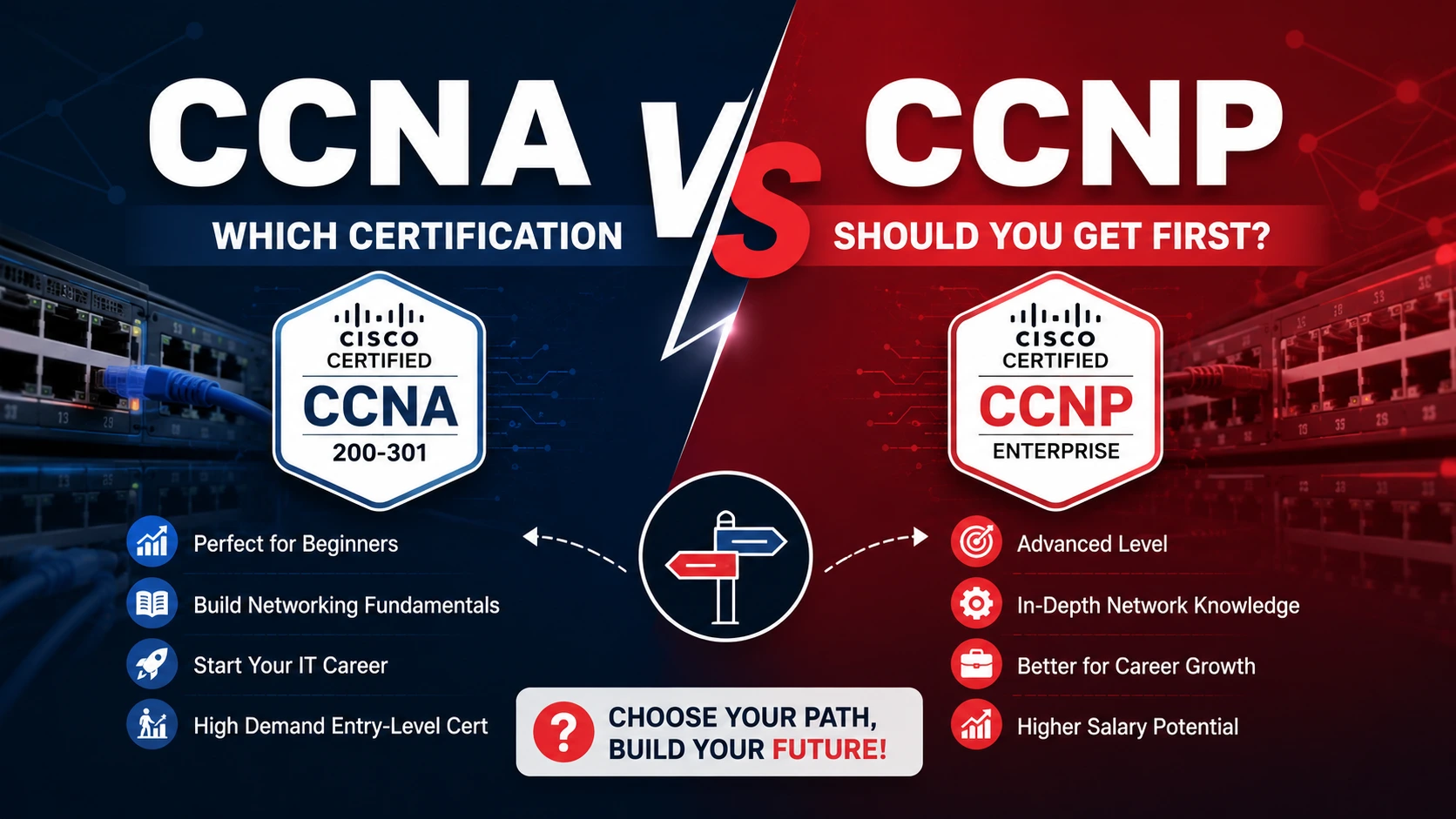
If you're deciding between CCNA and CCNP, read CCNA vs CCNP: Which Certification Should You Get First? before choosing a certification path.
What Comes After CCNA?
Once you've developed strong networking fundamentals and gained practical experience, you may decide to progress toward professional-level networking.
The DFW IT Career CCNP Training Course in Dallas focuses on advanced networking concepts and is positioned for learners with basic networking knowledge or prior certifications. Its current course page describes a hands-on, enterprise-oriented program and lists an experienced Cisco CCNA/CCNP instructor.
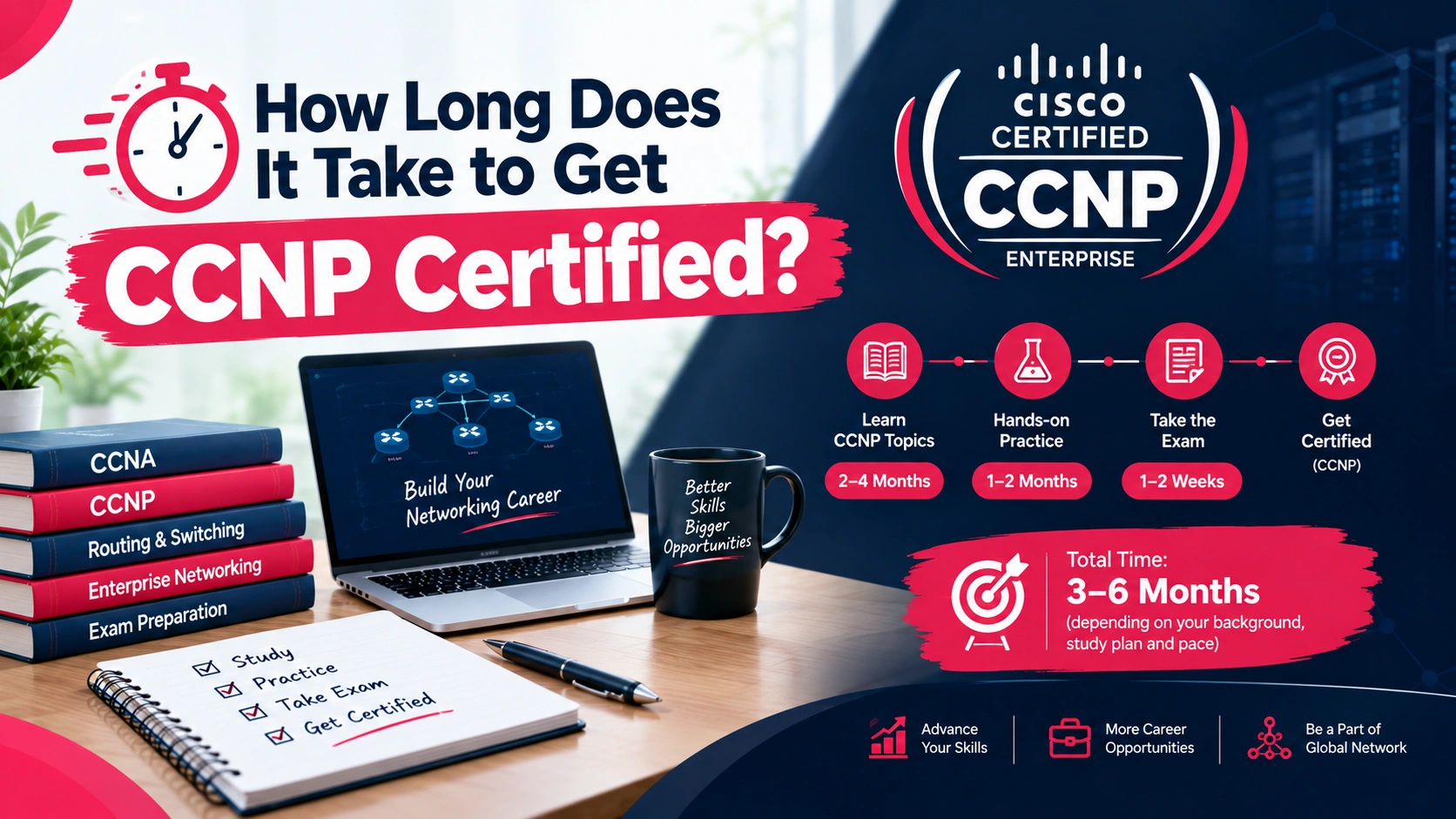
If you're considering the CCNP path, our guide How Long Does It Take to Get CCNP Certified? explains the preparation timeline, exam structure, and factors that can affect your study schedule.
Networking and Cybersecurity Are Closely Connected
Networking knowledge is also valuable when moving into cybersecurity.
Firewalls, network segmentation, access control, traffic monitoring, authentication, and secure network design all depend on understanding how networks work.
If you're interested in the security side of IT, you can explore DFW IT Career's Cyber Security (IAM) Training Program.
You can also read Top Cyber Security Certifications to Boost Your Career in Dallas to explore different cybersecurity certification paths.
Another useful resource is How to Build a Career in IAM: Step-by-Step Guide, which explains why networking knowledge is one of the foundational areas for people entering identity and access management.
Networking Is Also Useful in Other IT Roles
Networking isn't limited to network engineers.
Help desk professionals troubleshoot connectivity problems.
System administrators manage servers and network services.
Cybersecurity professionals monitor and protect network traffic.
DevOps professionals work with infrastructure and connectivity.
Cloud professionals deal with virtual networks, routing, security groups, and connectivity between services.
For beginners exploring IT careers, What Does a Tech Analyst Do? A Complete Guide in 2026 explains how technical support roles involve troubleshooting and foundational IT knowledge.
You can also read How Dallas Companies Value Help Desk Professionals to understand how support experience can contribute to an IT career path.
If your interests move toward infrastructure and automation, DevOps Engineering is another area worth exploring.
A Beginner's Networking Learning Path
If you're starting from zero, don't try to learn everything at once.
A practical progression can look like this:
Step 1: Learn Computer Networking Fundamentals
Understand:
- LAN and WAN
- IP addresses
- MAC addresses
- Subnets
- DNS
- DHCP
- TCP/IP
- Ethernet
Step 2: Learn Switching
Study:
- MAC address tables
- VLANs
- Trunking
- Access ports
- Broadcast domains
- STP fundamentals
Step 3: Learn Routing
Move into:
- Routing tables
- Static routing
- Dynamic routing
- Default routes
- Inter-VLAN routing
- IPv4 and IPv6
Step 4: Learn Network Security
Understand:
- Firewalls
- ACLs
- Network segmentation
- Secure remote access
- Authentication
- Basic threat concepts
Step 5: Practice
Build small network labs.
Break things intentionally.
Troubleshoot them.
The ability to diagnose a problem is often more valuable than simply memorizing definitions.
Step 6: Consider Certification
Once your fundamentals are strong, you can consider a certification such as CCNA and later progress toward more advanced networking certifications.
Common Beginner Mistakes
Mistake 1: Thinking a Router and Switch Are the Same
They aren't.
A switch primarily connects devices within a LAN, while a router connects different networks.
Mistake 2: Thinking a Firewall Is Just Another Router
A firewall's primary purpose is security policy enforcement.
Some firewalls can route traffic, but routing and firewalling remain different functions.
Mistake 3: Memorizing Without Understanding
Knowing that a switch uses MAC addresses isn't enough.
You should understand what happens when a frame enters a switch and how the switch decides where to send it.
Mistake 4: Ignoring Hands-On Practice
Networking is practical.
Build labs and troubleshoot problems rather than relying entirely on videos and notes.
Mistake 5: Assuming Every Device Has Only One Function
Modern networking equipment can combine routing, switching, wireless, and security capabilities.
Learn the underlying functions first.
Related IT Career Resources
If you're exploring networking as part of a larger IT career plan, these DFW IT Career resources may also help:
- How to Start a Career in AI & Machine Learning — for readers considering other technical career paths.
- AI vs Data Science: What's the Difference? — useful if you're comparing technology career specializations.
- How AI Is Changing Software Testing in 2026 — an introduction to the changing software-testing landscape.
- Step-by-Step Guide to Becoming a QA Automation Expert — for readers interested in QA and automation.
These areas are different from networking, but understanding the broader IT landscape can help you make a more informed career decision.
Frequently Asked Questions
Is a router the same as a switch?
No. A switch primarily connects devices within a local network, while a router connects different networks and routes IP traffic between them.
Is a firewall the same as a router?
No. A router primarily performs network connectivity and routing, while a firewall applies security policies to control traffic. Some modern devices combine both functions.
Can a switch replace a router?
A basic Layer 2 switch generally cannot replace a router when traffic needs to be routed between different IP networks. A Layer 3 switch, however, can perform routing functions.
Can a router have a firewall?
Yes. Some routers include firewall functionality. Modern secure routers may integrate more advanced security capabilities as well.
Which is easier to learn: router or switch?
The basic concepts of switching are often easier for networking beginners because they start with local device connectivity. However, both switching and routing become more advanced as you move into enterprise networking.
Do I need to learn networking before cybersecurity?
Strong networking fundamentals are highly useful for cybersecurity because many security controls and threats involve network communication. However, the exact knowledge required depends on the cybersecurity specialization.
Is CCNA useful for learning routers and switches?
Yes. CCNA-level networking study covers fundamental networking concepts, routing, switching, IP connectivity, security basics, and troubleshooting. DFW IT Career's current CCNA program specifically includes these areas and hands-on practice.
Should beginners start with CCNA or CCNP?
For most beginners, CCNA-level knowledge is the more appropriate starting point. CCNP is a professional-level path and is better approached after developing a strong networking foundation. You can read CCNA vs CCNP: Which Certification Should You Get First? for a detailed comparison.
Final Thoughts
Understanding router vs switch vs firewall is one of the first important steps toward becoming comfortable with computer networking.
Remember the basic distinction:
Switch = connects devices.
Router = connects networks.
Firewall = protects and controls traffic.
In a real network, these functions often work together rather than operating independently.
As you continue learning, move beyond memorizing definitions. Practice following a packet through a network. Ask where it starts, how the switch handles the frame, how the router determines the next hop, and how security controls decide whether traffic should be permitted.
That practical way of thinking will help you build a stronger foundation for networking certifications, cybersecurity, cloud infrastructure, systems administration, and other IT careers.
If you're beginning your networking journey, explore the CCNA Training Course in Dallas. If you already have networking fundamentals and want to move toward professional-level skills, you can also explore the CCNP Training Course in Dallas.
The goal isn't simply to know what a router, switch, or firewall is.
The goal is to understand how they work together to build a functional, reliable, and secure network.