Generative AI vs Agentic AI: What's the Real Difference?
 Nov 15, 2026
 04:57 AM
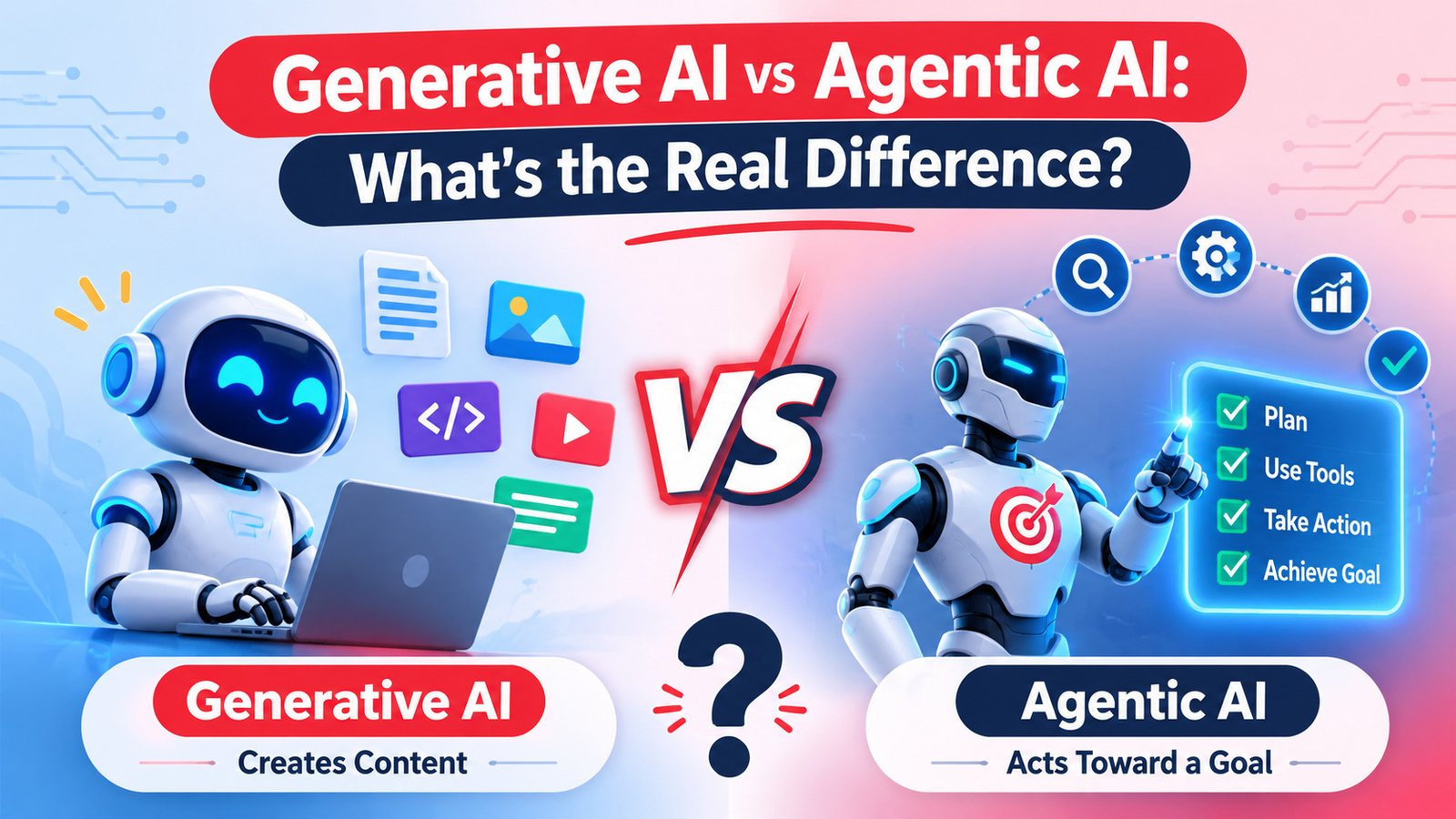
Artificial intelligence has moved far beyond simple automation and rule-based software. Generative AI can create text, images, code, audio, and other types of content, while newer agentic AI systems can use AI models, tools, data, and workflows to work toward a defined goal. That difference sounds simple, but the terms are often used interchangeably. So, what is the real difference between Generative AI and Agentic AI? The easiest way to understand it is this:
Generative AI primarily creates. Agentic AI primarily acts toward a goal. A generative AI application might write an email, summarize a document, create code, or generate an image after receiving a prompt. An agentic AI system can take a broader objective, break it into steps, use connected tools, evaluate information, and continue working through a workflow with less direct instruction from the user.
Agentic systems can still use generative AI. In fact, many modern AI agents rely on generative models to understand instructions, reason about tasks, generate content, and communicate with users. IBM similarly describes agentic AI as building on generative AI capabilities by adding planning, tool use, decision-making, and interaction with external systems. Let's break down the difference in practical terms.
Generative AI vs Agentic AI: Quick Comparison
Feature
Generative AI
Agentic AI
Primary purpose
Create content or generate responses
Achieve a goal or complete a workflow
Typical behavior
Mostly prompt-driven
Goal-driven
Output
Text, images, code, audio, video, etc.
Decisions, actions, workflows, and sometimes generated content
Autonomy
Usually requires continued user direction
Can operate through multiple steps with less intervention
Tool usage
May use tools when integrated
Tool usage is commonly central to the workflow
Planning
Usually limited to the immediate request
Can plan and execute multiple steps
Best suited for
Content creation, Q&A, summarization, ideation
Automation, research, multi-step tasks, workflow execution
Human involvement
Often higher
Can be lower, depending on design and permissions
Example
Generate a customer email
Analyze a customer request, check CRM data, draft a response, and update the workflow
The distinction is not absolute. A generative AI application can have tool access, and an agentic system can generate content. The important difference is the overall system behavior and objective.
What is Generative AI?
Generative AI refers to AI systems designed to create new content based on patterns learned from data and the context provided to them. Depending on the model, the output may include:
- Text
- Images
- Software code
- Audio
- Video
- Summaries
- Reports
- Translations
- Structured responses
Large language models are one important category within modern generative AI. Generative systems can take an instruction such as "write a product description" or "explain this Python function" and produce a response based on the prompt and available context. For Example, imagine a software developer working on a project.
The developer could ask a generative AI tool:
"Write a Python function that validates an email address."
The system generates code. The developer reviews it, modifies it if necessary, tests it, and decides what to do next. That is a typical generative AI interaction.
The model is highly useful, but the user remains responsible for directing the workflow. This is one reason learning the fundamentals of AI matters. DFW IT Career's Generative AI Course in Dallas covers generative AI concepts, prompt design, LLMs, AI applications, model evaluation, responsible AI use, and practical implementation. The course also covers topics such as handling hallucinations, AI safety, deployment, monitoring, and governance.
Common Generative AI Use Cases
Generative AI is particularly useful when the primary requirement is to create or transform information. Examples include:
1. Content Creation
Marketing teams can use generative AI to create initial drafts for:
- Blog posts
- Product descriptions
- Social media copy
- Email drafts
- Advertising concepts
Human review is still important because generated content can contain factual errors, inappropriate wording, or unsupported claims.
2. Software Development
Developers can use generative AI for:
- Code suggestions
- Documentation
- Test cases
- Debugging assistance
- Code explanations
- Refactoring ideas
This connects naturally with software testing. If you're interested in how AI is changing the testing process, See How AI is Changing Software Testing in 2026.
3. Summarization and Research Assistance
Generative AI can summarize large amounts of information, extract key points, or help organize research.
However, summarization should not automatically be treated as fact verification. Important business, legal, financial, security, or technical decisions still require appropriate human validation.
4. Image, Audio and Video Generation
Generative models can produce or transform multimedia content based on instructions. This makes them useful for creative work, prototyping, marketing, design, education, and other applications.
What is Agentic AI?
Agentic AI refers to AI systems designed to pursue a goal by deciding what steps to take, using available tools or systems, evaluating results, and continuing through a workflow with varying levels of autonomy. Instead of simply answering:
"What should I do?"
An agentic system may be designed to actually work through:
- Understanding the objective
- Breaking the objective into tasks
- Gathering relevant information
- Selecting tools
- Performing actions
- Checking results
- Adjusting the next step
- Reporting the outcome
This is why agentic AI is closely associated with AI agents and autonomous workflows. IBM describes AI agents as systems that can autonomously perform tasks by designing workflows and using available tools. Agentic systems can also coordinate multiple agents for more complex objectives.
OpenAI's recent discussion of agents also highlights the shift from individual chatbot interactions toward longer-horizon tasks in which agents can orchestrate tool calls, interact with environments, and iterate toward a solution.
A Simple Example of Agentic AI
Imagine a company wants to automate part of its IT support process. A traditional generative AI system might answer:
"Here are some possible solutions for a user who cannot access their account."
An agentic system could potentially be designed to:
- Read the support request.
- Identify the type of access problem.
- Check approved knowledge sources.
- Look up relevant account information.
- Determine the next permitted action.
- Create or update a support ticket.
- Ask for human approval if the action is sensitive.
- Execute an approved workflow.
- Record what happened.
The important difference is that the system isn't simply generating an answer. It is participating in a multi-step process. Of Course, whether an AI agent should be allowed to perform each action depends on its permissions, system architecture, security controls, and human-approval requirements.
Generative AI vs Agentic AI: The Real Difference
The biggest difference is not simply "one generates content and one does not." Agentic AI can generate content too. The deeper difference is purpose and behavior. Generative AI is generally optimized around producing an output in response to an input. Agentic AI is designed around accomplishing an objective through a sequence of actions. Think about the difference between a writer and an assistant who manages an entire project. A writer might produce the report. An assistant might:
- Research the topic
- Collect information
- Organize the findings
- Draft the report
- Check requirements
- Revise the document
- Submit it to the appropriate system
The second workflow is closer to the concept of agentic AI.
1. Prompt-Driven vs Goal-Driven
Generative AI commonly starts with a prompt. For Example:
"Write a 1,000-word article about cloud security."
The system generates the article. Agentic AI can start with a broader goal:
"Prepare a competitive analysis of five cloud security platforms."
The system may need to determine which steps are necessary to accomplish the objective. This makes agentic systems more suitable for complex workflows.
2. Response vs Action
Generative AI generally produces a response. Agentic AI may produce a response and take an action through connected tools. For Example:
Generative AI:
"Here is a draft email to the customer."
Agentic AI:
"Review the customer request, retrieve the order details, prepare the appropriate response, and route it for approval."
The agent may interact with databases, APIs, enterprise applications, search systems, or other tools depending on its architecture.
3. Single-Step vs Multi-Step Workflows
Generative AI often performs a task within a single interaction. Agentic AI is better suited to multi-step workflows. For Example:
Generative AI workflow:
Prompt → Generate answer
Agentic AI workflow:
Goal → Plan → Retrieve information → Use tools → Evaluate → Act → Verify → Report
The exact architecture varies from one agent system to another, so "agentic" should not be treated as a guarantee that a system is completely autonomous.
How Do Generative AI and Agentic AI Work Together?
This is where the comparison becomes more interesting. Generative AI and Agentic AI are not necessarily competing technologies. In many systems, they complement each other. A simplified architecture could look like this:
User Goal → Agent → Planning → Generative AI Model → Tools → Data → Evaluation → Action
The generative model may provide language understanding and content generation. The agent layer can manage the workflow. The tools allow the system to interact with external environments. For Example, an AI agent could use a language model to understand:
"Find the latest information about this product and prepare a comparison."
The agent could then retrieve information from approved sources, organize it, compare the results, and prepare an output. This is one reason agentic AI is often described as an extension or orchestration layer around generative AI rather than a completely separate replacement.
Generative AI vs Agentic AI Use Cases
Both technologies have valuable applications, but their strengths are different.
Generative AI Use Cases
Generative AI works well for:
- Content generation
- Coding assistance
- Image generation
- Document summarization
- Translation
- Brainstorming
- Report drafting
- Customer communication
- Educational assistance
- Data interpretation
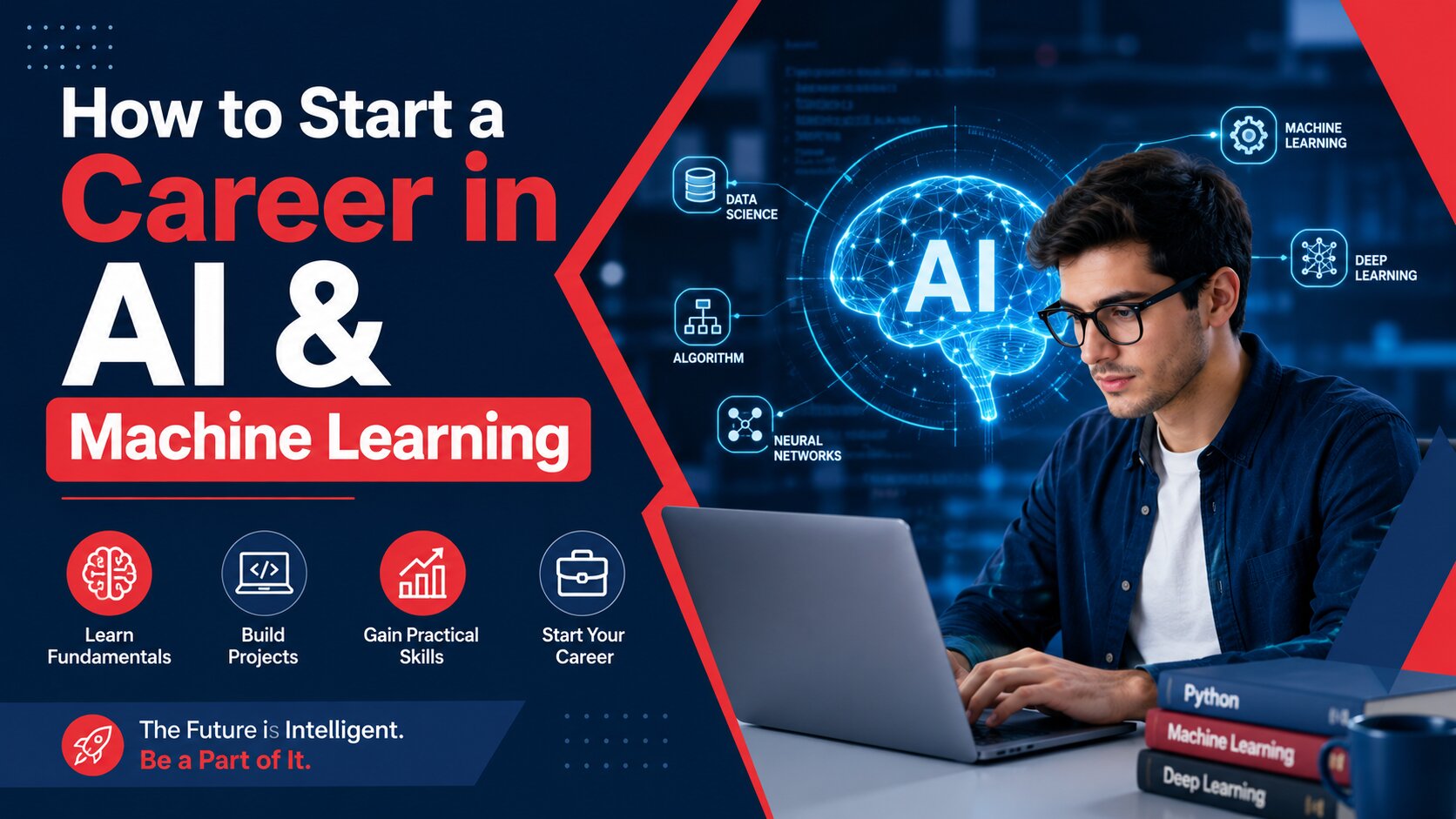
For a deeper introduction to AI and its broader technical foundations, DFW IT Career also offers an AI & Machine Learning Course, covering Python, machine learning, deep learning, NLP, model deployment, and practical projects. You can also read How to Start a Career in AI & Machine Learning for a career-oriented introduction to the field.
Agentic AI Use Cases
Agentic AI can be useful for:
- IT workflow automation
- Research workflows
- Customer support processes
- Software development workflows
- Business process automation
- Data retrieval and analysis
- Multi-step administrative tasks
- Monitoring and response workflows
- Enterprise process orchestration
- Multi-agent collaboration
The key requirement is not simply having an AI model. The system needs an appropriate architecture, tools, permissions, data access, monitoring, and safeguards.
Is Agentic AI Better Than Generative AI?
Not necessarily. This is one of the most important points to understand. Agentic AI is not automatically better simply because it is more autonomous. The right technology depends on the problem. If you need to generate ten product descriptions, a generative AI system may be sufficient. If you need to coordinate a multi-step workflow across several business systems, an agentic architecture may make more sense.
For example:
Business Need
Better Fit
Write an article
Generative AI
Generate an image
Generative AI
Summarize a document
Generative AI
Generate code suggestions
Generative AI
Automate a multi-step workflow
Agentic AI
Coordinate multiple tools
Agentic AI
Complete a goal across several systems
Agentic AI
Create content and then trigger workflows
Both
The practical question should therefore be:
"What does the business process actually require?"
—not—
"Which AI technology is newer?"
Benefits of Generative AI
Generative AI can provide several practical advantages.
Faster Content Production
It can help users create first drafts much faster.
Better Accessibility to Technical Tasks
People without advanced programming or design skills can use natural-language instructions to produce useful outputs.
Productivity Support
Generative AI can assist with repetitive writing, summarization, coding, documentation, and brainstorming.
Rapid Prototyping
Teams can quickly test ideas before investing significant development resources. But these benefits do not remove the need for human oversight. Generated information can be incomplete, outdated, incorrect, or misleading. High-impact decisions should therefore include appropriate verification.
Benefits of Agentic AI
Agentic systems can provide additional value when a workflow contains multiple connected steps.
Workflow Automation
Agents can coordinate multiple tasks rather than simply generating one response.
Tool Integration
Agents can interact with approved software, APIs, databases, and other systems.
Goal-Oriented Execution
The user can potentially specify the desired outcome without manually describing every intermediate step.
Continuous Evaluation
Some agent architectures can evaluate intermediate results and modify their next action.
Multi-Agent Collaboration
Multiple specialized agents can potentially work together, with each agent responsible for a particular part of a larger process. DFW IT Career's Agentic AI Course in Dallas focuses on intelligent agents, autonomous systems, agent design, decision-making frameworks, multi-agent systems, workflow integration, monitoring, evaluation, and responsible use.
What Are the Risks of Agentic AI?
The increased ability to take action also creates additional risks. A generative AI system that produces an incorrect answer is a problem. An agent that produces an incorrect decision and then acts on it can create a larger problem.
Potential concerns include:
- Incorrect actions
- Excessive permissions
- Data privacy issues
- Security vulnerabilities
- Prompt injection
- Unauthorized tool usage
- Poorly defined goals
- Hallucinated information
- Insufficient monitoring
- Lack of human approval
- Unexpected behavior across long workflows
For this reason, responsible agentic AI development should consider access controls, logging, monitoring, testing, human oversight, data governance, and clearly defined boundaries. This is also where cybersecurity becomes relevant.
AI systems that connect to enterprise applications may have access to sensitive information or operational systems. Understanding identity, authentication, authorization, and permissions can therefore become important when deploying AI-enabled workflows.
For learners interested in that side of technology, DFW IT Career's Cyber Security (IAM) course covers identity lifecycle management, authentication, authorization, MFA, SSO, RBAC, identity governance, and tools such as Okta, Azure AD, and Ping Identity.
You can also read How to Build a Career in IAM: Step-by-Step Guide to understand how identity and access management fits into the broader cybersecurity field.
Generative AI vs Agentic AI for IT Careers
If you're considering a career in AI, you don't necessarily need to choose one technology immediately. A strong foundation can include:
- Artificial intelligence fundamentals
- Machine learning basics
- Python
- Data handling
- APIs
- Cloud concepts
- Software development
- Automation
- Cybersecurity
- AI safety
- System design
For someone starting from the beginning, learning the fundamentals is often more valuable than jumping directly into the newest framework. DFW IT Career's AI & Machine Learning program provides a broader technical foundation, while its Generative AI Course focuses more directly on generative models, prompting, applications, deployment, evaluation, and responsible AI.
For Learners interested in autonomous workflows, The Agentic AI Course provides a more specialized path into agents and autonomous systems.
How Other IT Skills Connect to Agentic AI
Agentic AI doesn't exist in isolation. Real-world AI systems often depend on several areas of IT.
Software Testing
AI-generated code and AI-powered applications need testing. That's why QA automation remains relevant. DFW IT Career's QA Automation with AI course covers automated testing, Selenium, Cucumber, TestNG, Rest Assured, and practical testing workflows.
If you're exploring this career path, Read Step-by-Step Guide to Becoming a QA Automation Expert.
DevOps and Deployment
AI applications still need reliable deployment, monitoring, infrastructure, and operational processes. That makes DevOps knowledge useful for professionals working with production AI systems. DFW IT Career also offers DevOps Engineering training for learners building skills around modern software and infrastructure workflows.
Networking
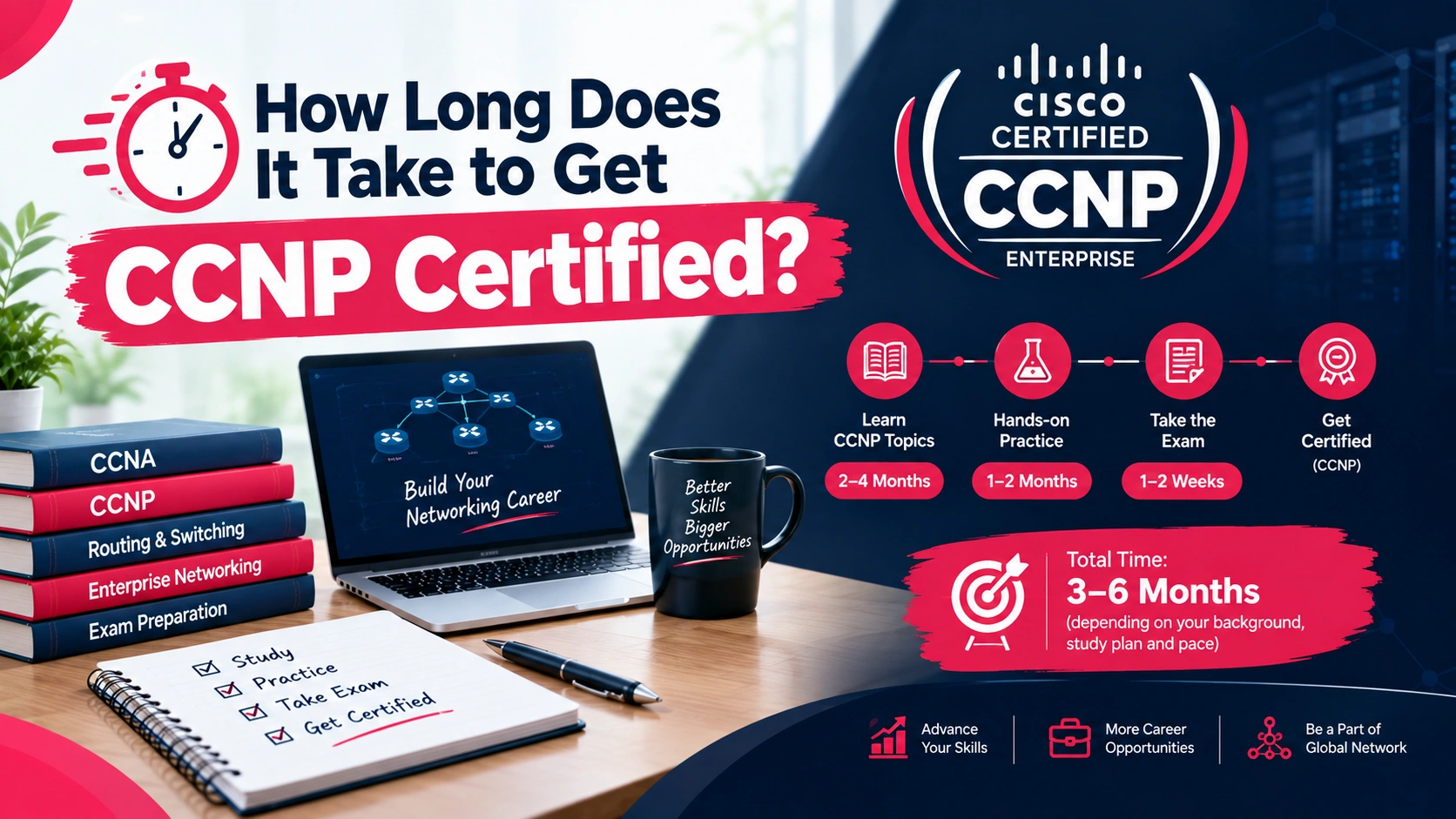
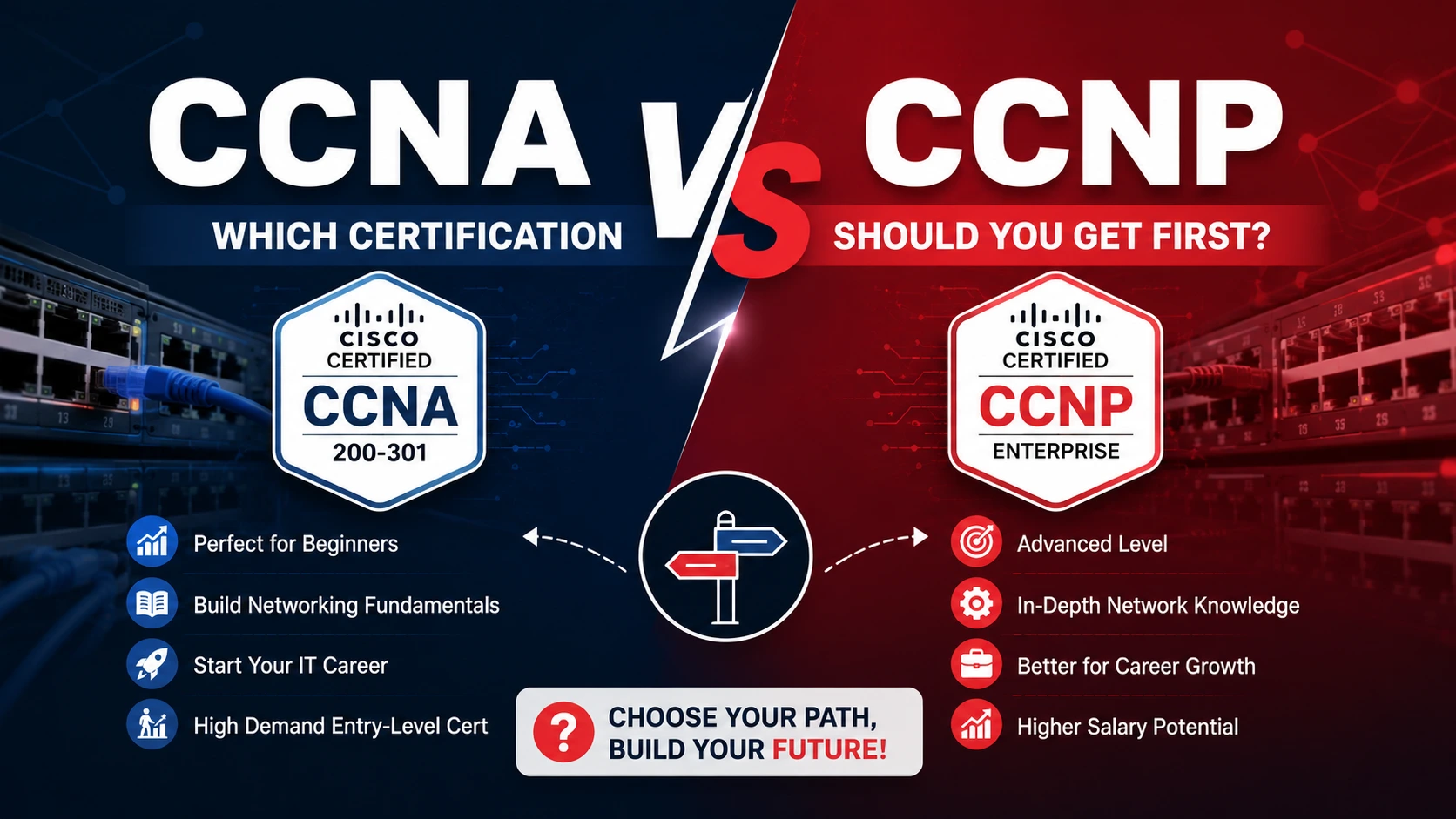
AI applications depend on networks, cloud services, APIs, and connected systems. A solid networking foundation can therefore be valuable, especially for professionals moving toward infrastructure, cloud, cybersecurity, or enterprise technology. For Networking fundamentals, see CCNA Training at DFW IT Career. For more advanced networking knowledge, CCNP Training is another option. You can also read CCNA vs CCNP: Which Certification Should You Get First? if you're deciding where to begin.
Does Generative AI Replace AI Agents?
No. In many cases, generative AI is actually one of the technologies that makes modern AI agents possible. An agent may use a generative model to:
- Understand natural-language instructions
- Interpret documents
- Generate plans
- Produce code
- Write messages
- Summarize information
- Communicate with users
- Decide which information needs further processing
The agentic layer then determines how those capabilities fit into a larger workflow. A useful mental model is:
Generative AI = intelligence for creating and understanding
Agentic AI = intelligence organized around achieving a goal
This is an oversimplification, but it is a useful starting point.
Generative AI vs Agentic AI: Which Should You Learn First?
For beginners, starting with the fundamentals of AI and generative AI is usually a sensible approach. Once you understand:
- AI and machine learning basics
- LLMs
- Prompting
- APIs
- Data
- Basic programming
- Model limitations
- Responsible AI
You can move into more advanced concepts such as:
- AI agents
- Tool calling
- Retrieval
- Workflow orchestration
- Multi-agent systems
- Agent evaluation
- AI observability
- Autonomous workflows
Your path can also depend on your existing background. Someone coming from software development may focus on AI engineering and agent development. Someone from QA may explore AI-assisted testing and automation. Someone from cybersecurity may focus on AI security, identity, access control, and secure AI deployment. Someone from business analysis may focus on AI-powered workflows and process automation.
If you're newer to IT, building foundational skills first can help. DFW IT Career's Tech Analyst / Help Desk training is another potential starting point for learners who want to establish core IT knowledge before specializing.
The related guide What Does a Tech Analyst Do? A Complete Guide in 2026 explains how the role fits into the broader IT career landscape.
How Dallas IT Professionals Can Think About Generative and Agentic AI
For professionals in Dallas, the important question isn't simply whether a company uses "Generative AI" or "Agentic AI."
Instead, look at the actual responsibilities.
A company may use generative AI for documentation, coding, customer communication, or analytics. Another company may use AI agents to automate parts of customer service, software development, internal operations, or IT support. That means the valuable skill is increasingly the ability to understand how AI fits into a real business process.
This also connects to broader cybersecurity and IT career development. For example, Top Cyber Security Certifications to Boost Your Career in Dallas can help readers explore cybersecurity learning paths, while How Dallas Companies Value Help Desk Professionals provides additional context for people considering an IT support foundation.
Other DFW IT Career Resources
AI is a broad field, and it overlaps with many other technology disciplines. If you're exploring different career paths, these DFW IT Career resources may also help:
- AI vs Data Science: What's the Difference? — Useful for understanding how AI and data science differ in focus and career direction.
- How AI is Changing Software Testing in 2026 — Explores the impact of AI on software testing.
- Step-by-Step Guide to Becoming a QA Automation Expert — Useful for readers considering QA automation.
- How to Start a Career in AI & Machine Learning — A useful starting point for learners exploring AI/ML careers.
- How to Build a Career in IAM — Useful for cybersecurity and identity-focused career planning.
- What Does a Tech Analyst Do? — Helpful for understanding an entry-level IT pathway.
- How Dallas Companies Value Help Desk Professionals — Explores the role of help desk skills in IT career development.
- Top Cyber Security Certifications to Boost Your Career in Dallas — Provides a cybersecurity certification overview.
- CCNA vs CCNP: Which Certification Should You Get First? — Useful for readers considering networking certifications.
Frequently Asked Questions
Is Agentic AI the same as Generative AI?
No. Generative AI focuses mainly on creating or transforming content, while agentic AI focuses on achieving goals through multi-step workflows, planning, tool use, and actions. Agentic systems may use generative AI as one component.
Is ChatGPT Generative AI or Agentic AI?
ChatGPT is fundamentally powered by generative AI, but AI applications built around language models can also include agentic capabilities. The distinction depends on what the overall system is designed and permitted to do.
What is the main difference between Generative AI and Agentic AI?
The simplest distinction is that generative AI primarily produces outputs such as text, images, or code, while agentic AI is designed to pursue a goal by planning and executing multiple steps.
Can Agentic AI work without Generative AI?
Yes, an AI agent does not necessarily have to use a generative model. However, many modern agentic systems use large language models or other generative models for natural-language understanding, planning, reasoning, and content generation.
Which is better for automation: Generative AI or Agentic AI?
For simple content-generation tasks, generative AI may be enough. For complex workflows involving multiple steps, tools, decisions, and external systems, an agentic architecture may be more appropriate.
Is Agentic AI fully autonomous?
Not necessarily. Agentic systems can operate with different levels of autonomy. Some require human approval for important actions, while others can perform predefined actions automatically. The appropriate level of autonomy depends on the use case, risk, permissions, and system design.
Is Generative AI easier to learn than Agentic AI?
For many beginners, generative AI concepts are a more accessible starting point. Agentic AI introduces additional concepts such as tool integration, workflow design, evaluation, orchestration, permissions, and system reliability.
Does learning Generative AI help with learning Agentic AI?
Yes. Understanding LLMs, prompting, APIs, AI limitations, and responsible AI can provide a useful foundation for learning how AI agents are designed and deployed.
Final Thoughts: Generative AI vs Agentic AI
The debate around Generative AI vs Agentic AI can make the technologies seem like competing alternatives, but the reality is more nuanced. Generative AI is excellent at producing and transforming information. Agentic AI extends AI into workflows where the system may plan, use tools, evaluate information, and take actions toward a defined objective. In many practical applications, the two work together. A modern AI system may use a generative model as its reasoning and communication engine while an agentic architecture manages tools, workflows, memory, decisions, and actions.
For professionals, that means learning one doesn't necessarily mean ignoring the other. A strong foundation in AI, software, data, automation, cybersecurity, and responsible technology use can make it easier to understand where generative and agentic systems fit into real-world organizations. And as the technology develops, the most valuable question may not be "Which AI is better?" It may be:
"What problem are we trying to solve, and what level of automation is actually appropriate?"
That question keeps the focus where it belongs—on useful technology, sound engineering, security, reliability, and measurable business value.